When Does an Ovarian Cyst Need Surgery? 7 Important Signs Women Should Know
Finding an ovarian cyst on an ultrasound can be worrying. Many women immediately wonder whether they need surgery, whether the cyst is dangerous, or whether it could affect their chances of becoming pregnant.
The good news is that most ovarian cysts do not require surgery. Many are harmless and disappear naturally over time.
However, some ovarian cysts need closer monitoring, further investigation or surgical treatment.
So, when does an ovarian cyst actually need surgery? Let’s understand the important signs, investigations and treatment options.
Quick Answer: When Does an Ovarian Cyst Need Surgery?
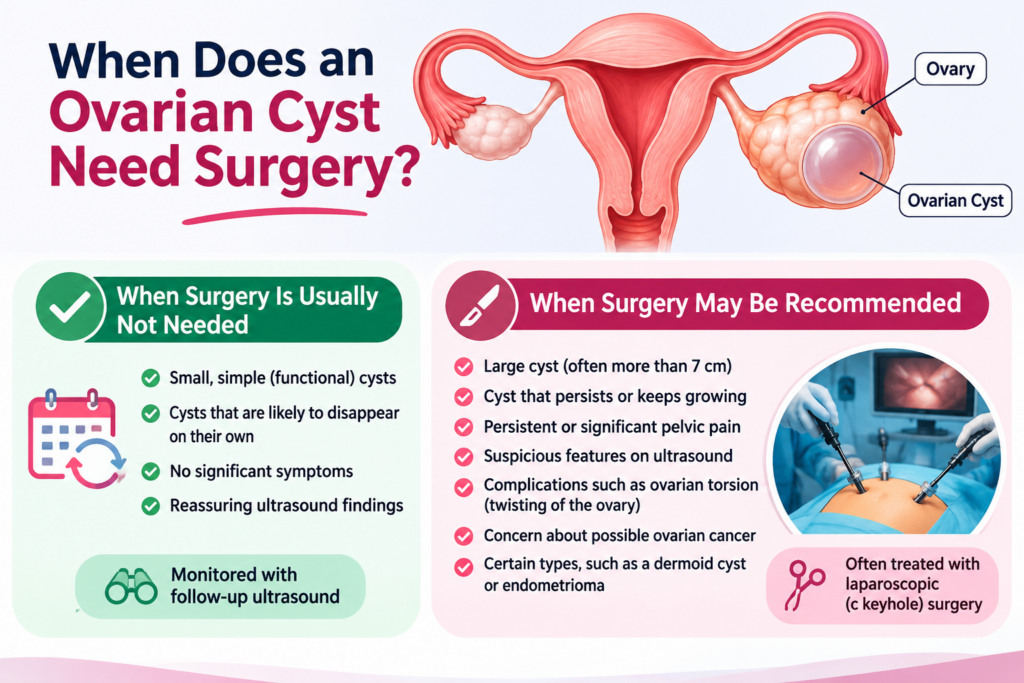
An ovarian cyst may need surgery when:
- It is very large or continues to increase in size.
- It persists over several menstrual cycles and does not resolve.
- It causes persistent or significant pelvic pain.
- It has suspicious features on ultrasound.
- It is associated with complications such as ovarian torsion.
- There is concern about possible ovarian cancer.
- It is a particular type of cyst, such as a dermoid cyst or endometrioma, for which surgery is considered appropriate.
Important: The size of an ovarian cyst alone does not determine whether surgery is necessary. Its appearance on ultrasound, symptoms, age, menopausal status and fertility plans are equally important.
Table of Contents
Table of Contents
1. What Is an Ovarian Cyst?
An ovarian cyst is a fluid-filled sac or pouch that develops in or on an ovary.
The ovaries are two small reproductive organs located on either side of the uterus. They release eggs and produce hormones such as oestrogen and progesterone.
Ovarian cysts are common in women during their reproductive years.
Some cysts develop as part of the normal menstrual cycle, while others occur due to conditions such as endometriosis or benign ovarian growths.
Common types of ovarian cysts
1. Functional cysts
These develop during the normal menstrual cycle. Follicular cysts and corpus luteum cysts are common examples.
Many disappear naturally within a few weeks or menstrual cycles.
2. Dermoid cysts
Also called mature cystic teratomas, these are usually benign growths that may contain tissues such as hair, fat and skin.
They do not usually disappear on their own.
3. Endometriotic cysts (Endometriomas)
These develop due to endometriosis and are sometimes called chocolate cysts because they contain old, thick blood.
4. Cystadenomas
These are usually benign ovarian growths that develop from the surface of the ovary. Some can grow considerably large.
Identifying the type of cyst is important because treatment differs depending on its characteristics.
2. Do All Ovarian Cysts Require Surgery?
No. Most ovarian cysts do not require surgery.
Many simple functional cysts disappear naturally without any specific treatment.
Your gynaecologist may recommend observation and a repeat ultrasound after an appropriate interval.
This approach is called watchful waiting.
However, some cysts remain unchanged, grow larger or develop features that require further evaluation.
The decision should always be individualised rather than based only on the fact that an ovarian cyst has been detected.
3. Seven Situations When Ovarian Cyst Surgery May Be Needed
1. The cyst is very large
A large ovarian cyst may cause abdominal discomfort, heaviness, bloating or pressure on nearby organs.
Larger cysts also need careful assessment because their complete appearance may not always be adequately evaluated on ultrasound.
Surgery may be considered depending on the size, appearance, symptoms and other clinical factors.
2. The cyst continues to grow
A cyst that increases in size during follow-up needs further evaluation.
Growth does not automatically mean cancer, but it may indicate that the cyst is not a temporary functional cyst.
Your doctor may recommend additional imaging or surgery depending on its characteristics.
3. The cyst does not disappear
Functional cysts often resolve naturally.
However, a cyst that remains present over several menstrual cycles, particularly if it is not a typical functional cyst, may need further investigation.
Persistent cysts such as dermoid cysts and cystadenomas are assessed differently from temporary functional cysts.
4. The cyst causes persistent pelvic pain
Some ovarian cysts cause:
- Lower abdominal pain.
- Pain on one side of the pelvis.
- Pain during sexual intercourse.
- Abdominal heaviness.
- Discomfort during physical activity.
- Persistent bloating or pressure.
If the pain is persistent or affecting your daily activities, a gynaecological assessment is important.
Surgery may be considered if the cyst is responsible for significant symptoms and other appropriate options are unsuitable.
5. The ultrasound shows suspicious features
Not all ovarian cysts look the same on ultrasound.
A simple cyst usually contains clear fluid and has a thin, smooth wall.
Features that need closer evaluation include:
- Solid areas within the cyst.
- Thick or irregular walls.
- Thick internal septations.
- Papillary projections.
- Increased blood flow within suspicious solid areas.
- Ascites or fluid in the abdomen.
These findings do not automatically confirm cancer.
However, they may indicate a need for specialist assessment, additional imaging, blood investigations or surgery.
6. There is a risk of ovarian torsion
Ovarian torsion occurs when the ovary twists around the tissues supporting it, potentially reducing or cutting off its blood supply.
It is a medical emergency.
Symptoms may include:
- Sudden, severe lower abdominal pain, often on one side.
- Nausea and vomiting.
- Severe abdominal tenderness.
- Pain that may come and go.
Immediate hospital assessment is necessary. Emergency surgery may be required to untwist the ovary and preserve ovarian function whenever possible.
7. There is concern about ovarian cancer
Most ovarian cysts are benign. However, certain ultrasound findings, age-related factors and menopausal status can increase concern.
A cyst in a postmenopausal woman requires appropriate assessment because the possibility of ovarian cancer needs to be considered.
Your doctor may recommend ultrasound, CA-125 blood testing and other investigations depending on the findings.
If cancer is suspected, referral to a gynaecological oncology specialist may be necessary.
4. What Ovarian Cyst Size Requires Surgery?
One of the most common questions women ask is: “My ovarian cyst is 5 cm or 7 cm. Do I need surgery?”
There is no single size at which every ovarian cyst must be removed.
The following is a simplified guide for women before menopause with a confidently characterised simple cyst.
| Cyst size | General approach |
|---|---|
| Less than 5 cm | Often resolves naturally; surgery is usually not needed for a simple cyst. |
| 5–7 cm | Ultrasound follow-up may be recommended. |
| More than 7 cm | Further assessment, MRI and/or surgery may be considered. |
These are general reference points, not automatic surgical cut-offs. Different imaging guidelines and individual clinical circumstances may lead to different follow-up recommendations.
Complex cysts, symptomatic cysts and cysts with suspicious ultrasound features require a different assessment regardless of size.
5. Which Ovarian Cysts May Need Surgery?
Different ovarian cysts require different approaches.
Functional cysts: Usually resolve naturally. Observation is often sufficient.
Dermoid cysts: Surgery may be considered if the cyst is growing, large, symptomatic or associated with a risk of complications such as torsion.
Endometriomas: Treatment depends on pain, cyst characteristics, age and fertility plans. Surgery is not automatically required for every endometrioma because ovarian reserve may be affected by surgery.
Cystadenomas: These may grow over time and may require surgical removal depending on their size, symptoms and imaging findings.
The important point is that treatment should be based on the type of cyst rather than simply calling every ovarian cyst the same condition.
6. What Are the Symptoms of a Problematic Ovarian Cyst?
Many ovarian cysts do not cause symptoms.
However, larger or symptomatic cysts may cause:
- Lower abdominal or pelvic pain.
- Pain on one side of the abdomen.
- Abdominal bloating or swelling.
- A feeling of heaviness in the lower abdomen.
- Frequent urination due to pressure on the bladder.
- Pain during intercourse.
- Difficulty with certain physical activities.
Warning signs that need urgent attention
Seek immediate medical attention if you experience:
- Sudden, severe abdominal or pelvic pain.
- Severe pain associated with vomiting.
- Fainting or severe dizziness.
- Sudden pain with fever or marked weakness.
These symptoms may indicate ovarian torsion, cyst rupture, internal bleeding or another urgent condition.
Do not wait for a routine appointment if these symptoms occur.
7. How Is an Ovarian Cyst Diagnosed?
The first step is understanding the patient’s symptoms and medical history.
Your gynaecologist may recommend the following investigations.
1. Pelvic ultrasound scan
Ultrasound is one of the most important investigations for evaluating ovarian cysts.
It helps assess:
- The size of the cyst.
- Its location.
- Whether it is filled with fluid or contains solid components.
- The thickness and appearance of its walls.
- Whether there are internal septations or projections.
- Blood flow within the lesion when Doppler assessment is indicated.
2. CA-125 blood test
CA-125 may be recommended in selected women, particularly when there are concerning ultrasound findings or when assessing an ovarian cyst after menopause.
An elevated CA-125 does not automatically mean ovarian cancer. It can also increase in benign conditions such as endometriosis and other inflammatory conditions.
It should always be interpreted along with clinical findings and imaging.
3. MRI scan
MRI may be recommended when an ultrasound does not provide enough information or when further characterisation of the cyst is necessary.
Not every woman with an ovarian cyst needs all these tests.
8. What Are the Treatment Options for Ovarian Cysts?
Treatment depends on the cyst type, size, symptoms, ultrasound appearance, age and reproductive plans.
Option 1: Observation
If the cyst appears benign and is not causing significant symptoms, your doctor may recommend observation with repeat ultrasound when appropriate.
Option 2: Medical management
Medicines may be used to manage associated pain or other symptoms.
Hormonal contraceptives may help prevent some future functional cysts by suppressing ovulation, but they do not reliably make an existing functional cyst disappear faster.
Medicines are not a substitute for evaluating a persistent or suspicious ovarian mass.
Option 3: Laparoscopic ovarian cyst removal
When surgery is appropriate and the cyst is considered suitable for minimally invasive treatment, laparoscopic surgery may be recommended.
It is performed using a camera and specialised instruments introduced through small abdominal incisions.
The aim is to remove the cyst while preserving healthy ovarian tissue whenever possible.
Option 4: Open surgery
In selected cases, open surgery may be necessary.
This may be considered when the cyst is extremely large, cannot be safely removed laparoscopically or when malignancy is suspected and intact removal is important.
The appropriate surgical approach depends on the individual patient.
9. Can Ovarian Cyst Surgery Affect Fertility?
This is a particularly important concern for women who are planning pregnancy.
The answer depends on the type of cyst, the amount of healthy ovarian tissue involved and the type of surgery performed.
In many cases, the surgeon can perform an ovarian cystectomy, which means removing the cyst while preserving the ovary.
However, some procedures, particularly surgery for endometriomas, may affect ovarian reserve.
Factors that influence fertility include:
- The type and size of the cyst.
- Whether one or both ovaries are involved.
- The woman’s age.
- Her ovarian reserve.
- Previous ovarian surgeries.
- The underlying condition.
- The amount of healthy ovarian tissue that can be preserved.
Before surgery, discuss your pregnancy plans and fertility concerns with your gynaecologist.
The goal, whenever medically appropriate, is to treat the cyst while preserving as much healthy ovarian tissue as possible.
10. What Happens During Laparoscopic Ovarian Cyst Surgery?
Laparoscopic ovarian cystectomy is a minimally invasive procedure used to remove selected ovarian cysts.
The procedure generally involves:
- General anaesthesia is administered.
- Small incisions are made in the abdomen.
- A laparoscope (camera) is inserted to view the pelvic organs.
- Specialised instruments are used to separate and remove the cyst where appropriate.
- The surgeon aims to preserve healthy ovarian tissue.
- The removed tissue is sent for histopathological examination.
What are the potential benefits?
For appropriately selected patients, laparoscopy may offer:
- Smaller abdominal incisions.
- Less postoperative discomfort.
- Shorter hospital stay.
- Faster recovery compared with open surgery in many cases.
- Smaller scars.
The final surgical approach depends on the cyst’s characteristics and the patient’s safety.
11. Common Myths About Ovarian Cysts
Myth 1: Every ovarian cyst requires surgery.
Fact: Most simple functional cysts resolve naturally. Many women only need observation and follow-up.
Myth 2: A 5 cm ovarian cyst always needs removal.
Fact: Size alone does not determine treatment. The cyst’s appearance, symptoms and other clinical factors are important.
Myth 3: Ovarian cysts always cause infertility.
Fact: Most ovarian cysts do not prevent pregnancy. Certain conditions, including endometriosis, may affect fertility.
Myth 4: Removing an ovarian cyst means removing the entire ovary.
Fact: In many cases, only the cyst can be removed while preserving healthy ovarian tissue. However, removal of an ovary may occasionally be necessary.
Myth 5: Every ovarian cyst is cancerous.
Fact: Most ovarian cysts are benign. However, suspicious cysts need appropriate evaluation.
12. Frequently Asked Questions About Ovarian Cysts
Can an ovarian cyst disappear without surgery?
Yes. Many functional ovarian cysts disappear naturally within a few weeks or menstrual cycles. Your doctor may recommend a repeat ultrasound to confirm resolution when appropriate.
Does a 5 cm ovarian cyst need surgery?
Not necessarily. A simple 5 cm cyst in a premenopausal woman may be monitored with ultrasound. Surgery depends on symptoms, cyst type, ultrasound findings and whether it persists or grows.
Does a 7 cm ovarian cyst require removal?
A cyst measuring 7 cm needs appropriate assessment. Depending on its appearance and symptoms, your gynaecologist may recommend follow-up imaging, MRI or surgery. The measurement alone does not establish the need for an operation.
Can ovarian cysts cause infertility?
Most ovarian cysts do not directly cause infertility. However, endometriomas and certain underlying conditions may affect fertility. Treatment decisions should consider the woman’s age and pregnancy plans.
Can ovarian cysts come back after surgery?
Yes. Some types of ovarian cysts can recur, depending on their underlying cause. Endometriomas, in particular, may recur after surgery. Follow-up care is important.
Is laparoscopic surgery suitable for every ovarian cyst?
No. Laparoscopy is suitable for many cysts considered benign, but not all. Very large cysts or masses with suspicious features may require a different surgical approach.
Will my ovary be removed during ovarian cyst surgery?
Not always. In many cases, the surgeon can remove only the cyst and preserve the ovary. However, removal of the ovary may be necessary if it is severely damaged, replaced by the cyst or malignancy is suspected.
Can I become pregnant after ovarian cyst removal?
Many women can become pregnant after ovarian cyst removal, especially when healthy ovarian tissue is preserved. The outcome depends on age, ovarian reserve, cyst type and other fertility factors.
Does an ovarian cyst after menopause need surgery?
Not necessarily, but it needs careful evaluation. Menopausal status, ultrasound appearance, size and CA-125 findings help guide management. Some small, simple cysts can be monitored, while suspicious masses need specialist assessment.
Is ovarian cyst surgery dangerous?
Like any operation, ovarian cyst surgery has potential risks, including bleeding, infection, injury to surrounding organs and effects on ovarian tissue. Your surgeon will discuss the benefits, risks and alternatives before recommending surgery.
13. When Should You Consult a Gynaecologist?

Consider a consultation if:
- Your ultrasound has detected an ovarian cyst.
- You have persistent lower abdominal pain.
- You experience repeated abdominal bloating or discomfort.
- Your cyst is increasing in size.
- You have been advised to undergo ovarian cyst surgery.
- You have an ovarian cyst and are planning pregnancy.
- You have an ovarian cyst after menopause.
An ovarian cyst diagnosis does not automatically mean that you need an operation.
A proper evaluation helps determine whether observation, medical management, further investigations or surgery is the right option.
Key Takeaways
- Most ovarian cysts are benign.
- Many functional cysts disappear without surgery.
- Large, persistent or symptomatic cysts may need surgical evaluation.
- Suspicious ultrasound features require further assessment.
- Sudden severe abdominal pain requires emergency medical attention.
- Laparoscopic cyst removal may be suitable for selected patients.
- Fertility preservation should be considered before ovarian surgery.
Conclusion
An ovarian cyst does not always mean surgery. The right treatment depends on the type of cyst, its size, ultrasound appearance, symptoms, age and future pregnancy plans.
Some women need only observation, while others may benefit from laparoscopic ovarian cyst removal.
If you have been diagnosed with an ovarian cyst or have been advised to undergo surgery, seek an individualised assessment before making a treatment decision.
Ovarian Cyst Evaluation and Treatment in Nellore
At Dr. Rohini’s Gynaecology, Infertility & Maternity Clinic, Nellore, women can seek evaluation and guidance regarding ovarian cysts, endometriomas and other gynaecological conditions.
Dr. U.V. Rohini, MS (OBG), with 15 years of experience in Obstetrics and Gynaecology, provides personalised evaluation and discusses appropriate medical and surgical treatment options.
Laparoscopic ovarian cyst removal may be considered when clinically appropriate, with attention to preserving healthy ovarian tissue whenever possible.
Clinic: Dr. Rohini’s Gynaecology, Infertility & Maternity Clinic
Associated Hospital: Shine Speciality Hospital, Nellore, Andhra Pradesh.
Phone number:9490880960 or 9346423765
Website: https://www.drrohinigynae.com/
Medical References and Further Reading
For more information about ovarian cysts, diagnosis and treatment, refer to these trusted medical resources:
1. American College of Obstetricians and Gynecologists (ACOG): Ovarian Cysts – Symptoms, Diagnosis and Treatment
2. Royal College of Obstetricians and Gynaecologists (RCOG): Ovarian Cysts Before the Menopause
3. National Health Service (NHS): Ovarian Cyst Treatment
4. American College of Radiology (ACR): O-RADS – Ovarian-Adnexal Reporting and Data System
These resources provide evidence-based information about ovarian cyst evaluation, ultrasound assessment and available treatment options.