Ovulation Symptoms: 10 Signs You’re Most Fertile and Ready to Conceive
Are you trying to conceive and wondering how to recognise your most fertile days? Understanding ovulation symptoms can help you identify the time in your menstrual cycle when pregnancy is most likely.
Ovulation is the process in which an ovary releases an egg. It usually occurs once during an ovulatory menstrual cycle, but the exact timing can vary from woman to woman and from one cycle to another.
Some women notice changes in vaginal discharge, mild lower abdominal pain, increased sexual desire or breast tenderness around ovulation. Others experience no noticeable symptoms at all.
The most useful natural sign of approaching ovulation is often clear, slippery, stretchy cervical mucus. Ovulation predictor kits can provide additional information by detecting a rise in luteinising hormone (LH). However, neither symptoms nor a positive ovulation test guarantees that an egg has been released or that pregnancy will occur.
In this guide, Dr. Rohini’s Gynaecology, Infertility & Maternity Clinic in Nellore explains 10 possible ovulation symptoms, how to identify your fertile window, when to have intercourse if you are trying to conceive, and when fertility evaluation may be helpful.
What Are the 10 Common Ovulation Symptoms?
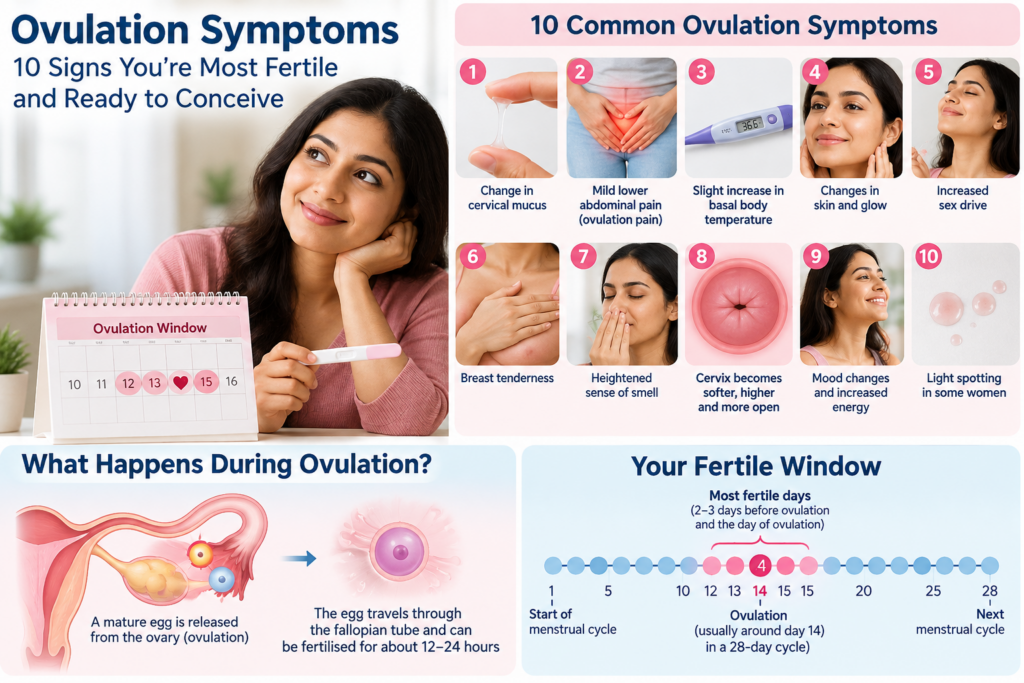
The 10 possible signs of ovulation are:
- Clear, stretchy vaginal discharge resembling raw egg white.
- Increased vaginal wetness and slippery cervical mucus.
- Mild lower abdominal pain or cramping.
- A slight rise in basal body temperature after ovulation.
- A positive urine ovulation predictor test.
- Increased sexual desire.
- Breast tenderness.
- Mild bloating.
- Light spotting in some women.
- Changes in the cervix that may be noticed by women who track cervical position.
Not every woman experiences these signs, and several symptoms can occur for reasons unrelated to ovulation.
1. What Is Ovulation?
Ovulation is the release of a mature egg from an ovary. After release, the egg enters the fallopian tube, where it may meet sperm and become fertilised.
Ovulation is an important part of the menstrual cycle, but successful conception also depends on factors such as sperm health, open fallopian tubes, the condition of the uterus and the timing of intercourse.
When does ovulation happen?
In a typical 28-day menstrual cycle, ovulation may occur around day 14. However, this is only an estimate.
Ovulation generally occurs about 14 days before the next menstrual period, rather than always on day 14 of the cycle.
For example:
- A 28-day cycle: ovulation may occur around day 14.
- A 30-day cycle: ovulation may occur around day 16.
- A 35-day cycle: ovulation may occur around day 21.
These are estimates, not guarantees. Women with irregular cycles may ovulate earlier, later or inconsistently.
2. Ten Ovulation Symptoms Explained
1. Clear, stretchy vaginal discharge
One of the most useful signs of approaching ovulation is a change in cervical mucus.
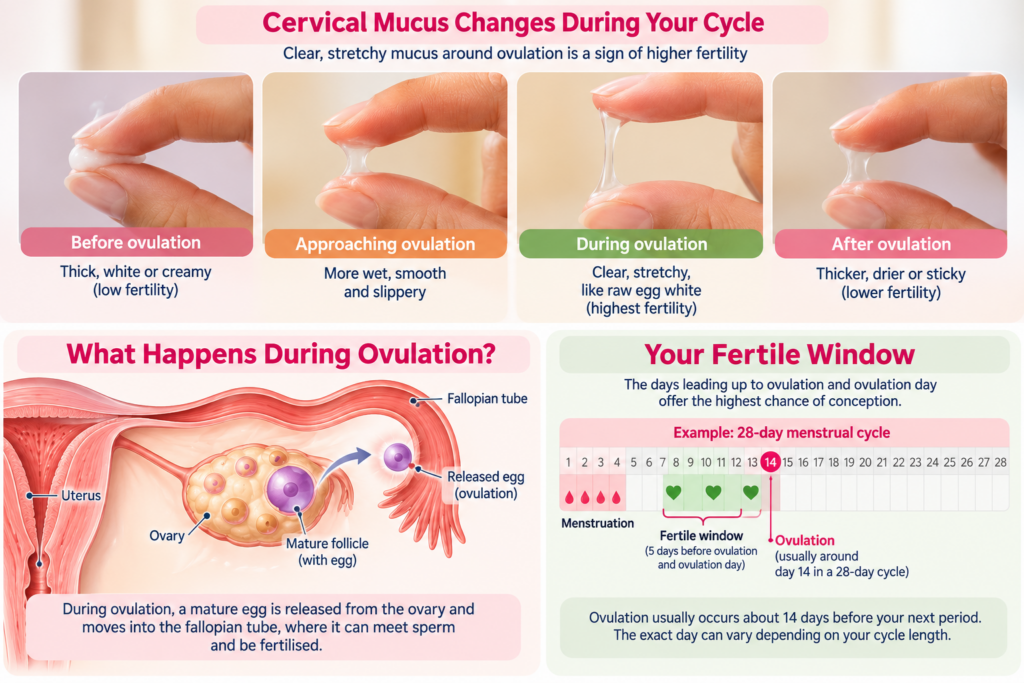
As oestrogen levels rise before ovulation, cervical mucus often becomes:
- Clear or transparent.
- Slippery and wet.
- Stretchy between the fingers.
- Similar in consistency to raw egg white.
This mucus helps sperm move through the reproductive tract and can indicate that the fertile window is approaching.
What should you do? If you are trying to conceive, consider having intercourse every one to two days while this fertile-type mucus is present.
Remember that normal cervical mucus varies, and the absence of egg-white discharge does not prove that you are not ovulating.
2. Increased vaginal wetness
Some women notice that their underwear feels wetter or that vaginal secretions increase around the middle of their cycle.
This may be caused by hormonal changes associated with the fertile window.
However, vaginal discharge can also change because of sexual arousal, infection, medications or other factors.
Consult a gynaecologist if discharge has a strong unpleasant smell or is associated with itching, burning, pelvic pain or unusual bleeding.
3. Mild lower abdominal pain
Some women experience mild pain on one side of the lower abdomen around ovulation. This is sometimes called mittelschmerz, a German term meaning middle pain.
The pain may feel like:
- A brief twinge.
- Mild cramping.
- A dull ache on one side of the pelvis.
It may last from a short time to several hours, and occasionally longer.
Ovulation pain is not experienced by everyone. Severe, persistent or worsening pain should not automatically be attributed to ovulation because ovarian cysts, pelvic infections, appendicitis and other conditions can cause similar symptoms.
Seek urgent medical assessment for sudden severe abdominal pain, particularly if accompanied by vomiting, fainting, fever or heavy bleeding.
4. A slight rise in basal body temperature
Basal body temperature (BBT) is your body temperature when you are fully at rest.
After ovulation, progesterone can cause a small rise in resting temperature. Tracking your temperature every morning before getting out of bed may reveal a sustained pattern over several cycles.
However, basal body temperature is more useful for recognising that ovulation may already have occurred than predicting when it will happen.
Fever, poor sleep, alcohol, shift work and changes in measurement time can affect the readings.
5. A positive ovulation predictor kit
Home ovulation predictor kits detect a rise in luteinising hormone in urine. This LH surge usually occurs shortly before ovulation.
A positive result suggests that ovulation may occur within approximately the next 24–48 hours, although timing varies and a positive result does not prove that an egg was released.
For women trying to conceive, the test can help identify a useful time to have intercourse.
Follow the kit’s instructions carefully. If your periods are irregular or you have PCOS, interpreting results may be more difficult because LH levels or surges can be atypical.
6. Increased sexual desire
Some women report an increase in sexual desire around the fertile window. Hormonal changes may contribute, but libido is also influenced by mood, stress, sleep, relationships and general health.
An increase in sexual desire is not a reliable way to confirm ovulation on its own.
7. Breast tenderness
Hormonal fluctuations during the menstrual cycle can cause breast fullness, sensitivity or tenderness.
Although some women notice breast changes around ovulation, breast tenderness is not specific to ovulation. It may also occur before menstruation or in early pregnancy.
If breast symptoms are persistent, unusual or associated with a lump or nipple changes, seek medical advice.
8. Mild bloating
Some women experience a sensation of abdominal fullness or mild bloating around the middle of their cycle.
This is a nonspecific symptom and may also be related to digestion, diet, constipation or other hormonal changes.
Bloating alone cannot tell you whether you are ovulating.
9. Light spotting
Occasionally, a small amount of spotting may occur around the time of ovulation.
However, bleeding between periods has several possible causes, including hormonal fluctuations, cervical conditions, infection, pregnancy-related bleeding and other gynaecological problems.
Do not assume that unexplained bleeding is ovulation spotting, especially if it recurs, becomes heavy or occurs with pain.
10. Changes in cervical position
Women who regularly monitor their cervical position may notice that the cervix feels softer, sits higher and is slightly more open around the fertile period.
This is a less dependable sign for most people. Cervical position is difficult to assess consistently and should not be used alone to predict ovulation or diagnose a fertility problem.
Which ovulation signs are most useful?
Cervical mucus changes and urine LH tests are particularly helpful for identifying the approaching fertile window. Basal body temperature may help recognise a pattern after ovulation.
Pain, bloating, breast tenderness and libido changes are much less specific.
No single symptom can reliably establish that ovulation has occurred in every woman.
3. When Are You Most Fertile?
The fertile window is generally considered to be the six-day period ending on the day of ovulation: the five days before ovulation and ovulation day itself.
This is possible because sperm can survive in the female reproductive tract for up to about five days under favourable conditions, whereas the egg generally remains capable of fertilisation for around 12–24 hours after ovulation.
The likelihood of conception is generally highest when intercourse occurs in the one to two days before ovulation.
A practical example
If ovulation is expected around day 14 of a 28-day cycle, the potential fertile window is approximately days 9–14.
Having intercourse every one to two days during this period is a reasonable approach.
You do not need to identify one exact hour or one perfect day. If tracking becomes stressful, regular intercourse two to three times per week throughout the cycle can also provide good coverage of the fertile window for many couples.
4. How to Calculate Your Ovulation Day
To estimate ovulation using your menstrual cycle:
- Record the first day of menstrual bleeding as cycle day 1.
- Track the length of several cycles.
- Estimate ovulation as occurring about 14 days before the next expected period.
- Use cervical mucus observations or an ovulation predictor kit to refine the estimate.
For example, if your cycle usually lasts 30 days, ovulation might occur around day 16.
But if your cycles vary between 26 and 35 days, a calendar calculation alone may not be sufficiently accurate.
Period-tracking apps can help record patterns, but their predictions are estimates. They cannot confirm ovulation, and their accuracy may be limited when cycle lengths vary.
5. How to Track Ovulation at Home
Method 1: Monitor cervical mucus
Look for discharge that becomes clear, slippery and stretchy as ovulation approaches.
Avoid douching or using vaginal products to assess discharge, as these can interfere with natural secretions and vaginal health.
Method 2: Use an ovulation test kit
Urine LH tests can help identify the hormone surge before ovulation.
Read the instructions for your particular product. If you repeatedly get positive results without clear cycle patterns, or never obtain a positive result despite regular testing, discuss the findings with your doctor.
Method 3: Record basal body temperature
Take your temperature at approximately the same time each morning, before getting out of bed, and record the results.
A sustained rise may support the possibility that ovulation has occurred, but temperature tracking cannot reliably predict the upcoming fertile window.
Method 4: Keep a menstrual calendar
Record:
- The first and last days of menstrual bleeding.
- Your usual cycle length.
- Changes in vaginal discharge.
- Ovulation test results.
- Any pelvic pain or spotting.
- Medicines and supplements you take.
This information can be useful during a fertility consultation.
6. Can You Ovulate Without Symptoms?
Yes. Many women do not notice any clear symptoms when they ovulate.
The absence of ovulation pain, egg-white discharge or breast tenderness does not automatically indicate an ovulation problem.
Likewise, experiencing these symptoms does not confirm that an egg has been released.
If your periods are regular, that can be reassuring, but cycle regularity alone does not answer every question about fertility. If conception is taking longer than expected, a doctor can determine whether ovulation assessment or other investigations are appropriate.
7. What Can Affect Ovulation?
Several factors may influence the timing or regularity of ovulation.
Polycystic ovary syndrome (PCOS)
PCOS can cause irregular periods and infrequent or absent ovulation in some women. Other features may include acne, increased facial hair or difficulty conceiving.
Not every woman with PCOS has the same symptoms, and a diagnosis requires appropriate clinical assessment.
Thyroid disorders
An underactive or overactive thyroid can affect menstrual cycles and reproductive function.
Elevated prolactin
High prolactin levels can interfere with the hormones responsible for ovulation.
Significant weight changes or excessive exercise
Major weight changes, inadequate nutrition and excessive exercise can disrupt hormonal signalling in some women.
Stress and illness
Significant stress or illness may temporarily affect the menstrual cycle, although the effect varies between individuals.
Age
Fertility generally declines with age, particularly as women approach their late 30s and 40s. Age can affect egg quantity and quality, so timely evaluation matters when pregnancy is a goal.
Other reproductive conditions
Endometriosis and certain ovarian or reproductive conditions may affect fertility, even when ovulation occurs.
8. How Do Doctors Assess Ovulation?
A doctor may first review your menstrual history, symptoms, age, duration of trying to conceive and relevant medical history.
Not every woman needs extensive testing. The investigations recommended depend on the clinical situation.
Blood tests
A progesterone blood test may be used to help assess whether ovulation has occurred. It is generally timed about one week before the expected next period, rather than automatically on day 21 for every woman.
Depending on the history, thyroid function, prolactin or other hormone tests may be appropriate.
Pelvic ultrasound
Ultrasound may help assess the ovaries, uterus and other pelvic structures. In selected situations, serial ultrasound monitoring can help track follicular development and provide evidence about ovulation timing.
Additional fertility investigations
When conception has been delayed, the assessment may also include evaluation of the fallopian tubes and semen analysis for the male partner.
Ovulation is only one part of fertility. Testing should be selected to answer a relevant clinical question rather than ordered routinely without a reason.
9. Practical Tips When Trying to Conceive
Have intercourse regularly
Intercourse every one to two days during the fertile window can help maximise the chance of conception. Couples who prefer not to track ovulation can consider regular intercourse two to three times per week.
Start folic acid before pregnancy
Women planning pregnancy are generally advised to take folic acid before conception and during early pregnancy. The appropriate dose depends on individual risk factors and medical advice.
Review medicines and health conditions
Discuss prescription medicines, supplements, chronic conditions and previous pregnancy complications with your doctor before trying to conceive. Do not stop prescribed medicines without medical guidance.
Maintain healthy habits
Aim for a balanced diet, adequate sleep, regular moderate physical activity and avoidance of smoking and recreational drugs. Limit alcohol while trying to conceive and review caffeine intake.
No particular food, supplement or sexual position guarantees pregnancy.
Include the male partner in fertility care
Sperm health also affects conception. When fertility evaluation is indicated, both partners may need assessment rather than assuming the problem is exclusively related to the woman.
10. Common Ovulation Myths
Myth 1: Every woman ovulates on day 14.
Fact: Ovulation timing varies with cycle length and can change between cycles.
Myth 2: Ovulation pain proves that an egg has been released.
Fact: Pain can have other causes and does not confirm ovulation.
Myth 3: No egg-white discharge means no ovulation.
Fact: Some women ovulate without noticing this discharge.
Myth 4: A positive ovulation kit guarantees pregnancy.
Fact: It suggests an LH surge, but conception also depends on other reproductive factors.
Myth 5: Intercourse must happen on the exact day of ovulation.
Fact: The fertile window includes the five days before ovulation as well as ovulation day.
Myth 6: If periods are regular, fertility is definitely normal.
Fact: Regular cycles can be reassuring, but they do not confirm normal sperm health, open fallopian tubes or every other factor needed for conception.
Myth 7: Certain foods can guarantee ovulation or pregnancy.
Fact: Good nutrition supports general health, but no specific food can guarantee ovulation or conception.
11. When Should You Consult a Gynaecologist?
Consider arranging a fertility consultation if:
- Your periods are persistently irregular or absent.
- You have signs suggestive of PCOS or a known reproductive condition.
- You experience severe pelvic pain or recurrent bleeding between periods.
- You have been trying to conceive for 12 months without success if you are younger than 35.
- You are 35 or older and have been trying for six months without success.
- You are over 40 or have a known fertility risk factor; earlier evaluation may be appropriate.
Seek urgent medical assessment for sudden severe pelvic pain, fainting, heavy bleeding or pain accompanied by fever or vomiting. If pregnancy is possible and you have pain or bleeding, urgent assessment is especially important to exclude an ectopic pregnancy.

12. Frequently Asked Questions About Ovulation Symptoms
What are the first signs of ovulation?
A change in cervical mucus is often one of the earliest useful signs. It may become clearer, wetter, slippery and stretchy as ovulation approaches. Some women also notice increased libido or mild pelvic discomfort, while others experience no symptoms.
How many days do ovulation symptoms last?
It depends on the symptom. Fertile-type cervical mucus may be present for several days, while ovulation pain may last minutes or hours and occasionally longer. A temperature rise generally persists after ovulation. Symptom duration alone cannot confirm ovulation.
Is clear, stretchy discharge a sign of ovulation?
It is a useful sign that the fertile window may be approaching. The discharge often becomes clear and slippery because of rising oestrogen. However, discharge patterns vary, and some women ovulate without noticing this change.
Can I get pregnant without ovulation symptoms?
Yes. Many women have no obvious ovulation symptoms and can still conceive. Symptoms are not required for ovulation to occur. If you are concerned about ovulation or have difficulty conceiving, a gynaecologist can advise whether testing is needed.
What is the best day to have intercourse to conceive?
The chance of conception is generally highest in the one to two days before ovulation. Because the exact day can vary, intercourse every one to two days during the fertile window is a practical approach. Regular intercourse throughout the cycle is another option.
Can ovulation occur with irregular periods?
Yes, but ovulation may be less predictable or may not occur in every cycle. Conditions such as PCOS and thyroid disorders can contribute to irregular cycles. If your periods are persistently irregular and you are trying to conceive, consider a medical assessment.
Does ovulation pain mean that I am fertile?
Mild mid-cycle pain may coincide with ovulation, but it does not prove that an egg has been released or that all other fertility factors are normal. Severe or persistent pain needs medical assessment rather than being assumed to be ovulation pain.
Can an ovulation test kit confirm ovulation?
No. Most home kits detect the LH surge that usually occurs before ovulation. A positive result suggests that ovulation may follow, but it does not prove egg release. A doctor may recommend appropriately timed progesterone testing or ultrasound monitoring when confirmation is clinically necessary.
When should I see a fertility specialist?
Seek evaluation after 12 months of trying if you are younger than 35, or after six months if you are 35 or older. Women over 40 and those with irregular periods, known reproductive conditions or other fertility risks may benefit from earlier assessment.
Can PCOS cause ovulation problems?
Yes. PCOS can cause infrequent or absent ovulation, which may make conception more difficult. However, many women with PCOS can conceive, sometimes with medical support. Treatment depends on the individual’s cycle pattern, health, fertility goals and other clinical findings.
What Women Should Know Before Their Consultation
You can make your appointment more useful by bringing:
- The first day of your last menstrual period.
- Dates and lengths of your recent menstrual cycles.
- Results from any ovulation predictor kits you have used.
- Details of any unusual discharge, pain or bleeding.
- A list of medicines and supplements.
- Information about how long you have been trying to conceive.
- Relevant previous medical records, scans and fertility investigations.
Useful questions to ask your doctor include:
- Am I likely to be ovulating regularly?
- Would an ovulation test or blood test be helpful?
- Do my symptoms suggest PCOS or another condition?
- When should my partner have a fertility assessment?
- How long should we continue trying before further investigations?
- Which pre-pregnancy supplements and health checks are appropriate for me?
Not every patient requires the same investigations. Your doctor will tailor the assessment to your symptoms, age, medical history and fertility goals.
Conclusion
Recognising ovulation symptoms can help you understand your menstrual cycle and plan intercourse during your most fertile days. Clear, slippery cervical mucus and urine LH tests are particularly useful for identifying the approaching fertile window, while symptoms such as breast tenderness, bloating and pelvic pain are less specific.
Remember that ovulation is only one part of conception. If your periods are irregular, you have concerning symptoms or pregnancy is taking longer than expected, personalised medical advice can help identify the next appropriate steps.
If you need guidance about ovulation, PCOS, fertility investigations or IUI, you can arrange a consultation at Dr. Rohini’s Gynaecology, Infertility & Maternity Clinic, Nellore, Andhra Pradesh.
Understanding your cycle is a helpful first step, but it does not replace an individual fertility assessment when one is needed.
Trusted Medical References for Ovulation Symptoms
For reliable information about ovulation, fertility awareness and the best time to conceive, refer to the following authoritative medical resources.
1. American Society for Reproductive Medicine (ASRM)
The American Society for Reproductive Medicine explains the fertile window, timing of intercourse, fertility awareness and factors that influence natural conception.
Read more: Optimizing Natural Fertility – ASRM
2. American College of Obstetricians and Gynecologists (ACOG)
Learn how cervical mucus changes and other fertility signs can help identify the days when pregnancy is most likely.
Read more: Trying to Get Pregnant? Here’s When to Have Sex – ACOG
3. American College of Obstetricians and Gynecologists (ACOG)
This resource explains fertility awareness methods, including monitoring cervical mucus, tracking menstrual cycles and measuring basal body temperature.
Read more: Fertility Awareness-Based Methods of Family Planning – ACOG
4. American College of Obstetricians and Gynecologists (ACOG)
If you have irregular periods or difficulty conceiving, learn about the medical evaluation that may be recommended to investigate possible fertility problems.
Read more: Evaluating Infertility – ACOG
Medical note: These resources provide general educational information. Ovulation patterns and fertility needs vary between women. Consult a qualified gynaecologist for individual assessment and advice.