
Ovarian Cyst Treatment in Nellore
Have you been diagnosed with an ovarian cyst during an ultrasound scan? Or are you experiencing lower abdominal pain, bloating or irregular periods?
An ovarian cyst is a fluid-filled sac that develops in or on an ovary. Many ovarian cysts are harmless and disappear naturally, while some may require medical monitoring or treatment.
The right treatment depends on the type, size and appearance of the cyst, your symptoms, age and reproductive plans.
At Dr. Rohini’s Gynaec, Infertility and Maternity Clinic, Nellore, women can receive individualised gynaecological evaluation and guidance for ovarian cyst management.
Dr. Rohini, MS (OBG), with 15 years of experience in Obstetrics and Gynaecology, focuses on understanding each patient’s condition and discussing appropriate treatment options.
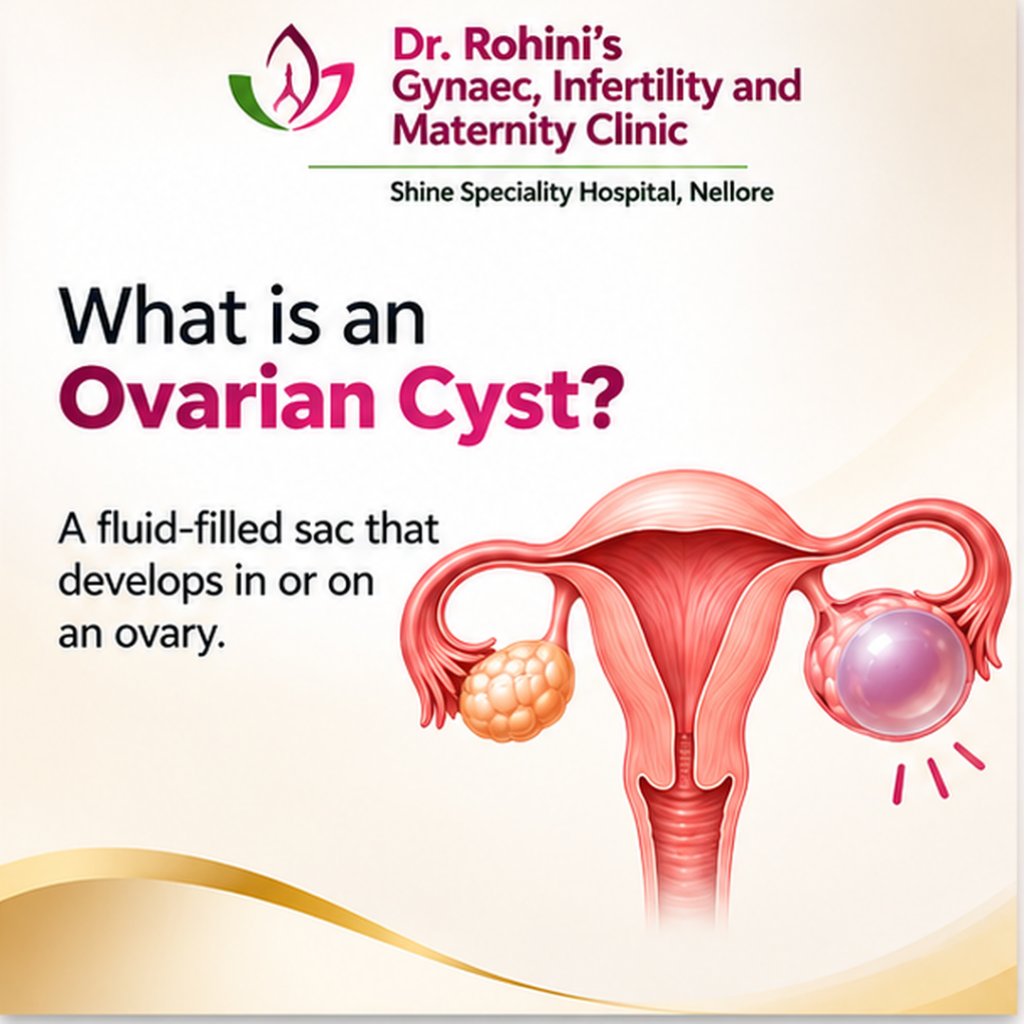
What Is an Ovarian Cyst?
An ovarian cyst is a sac filled with fluid or other material that develops in or on one of the ovaries.
The ovaries are reproductive organs located on either side of the uterus. They produce hormones and release eggs during the menstrual cycle.
Ovarian cysts can develop at different stages of a woman’s reproductive life.
Common types of ovarian cysts
1. Functional ovarian cysts
These are associated with the normal menstrual cycle.
- Follicular cysts develop when a follicle does not release an egg or continues growing.
- Corpus luteum cysts develop after the egg is released.
Many functional cysts resolve without treatment.
2. Endometrioma
An endometrioma, sometimes called a chocolate cyst, develops due to endometriosis affecting the ovary. It may be associated with painful periods, pelvic pain and fertility difficulties.
3. Dermoid cyst
A dermoid cyst develops from reproductive cells and may contain different types of tissue, including fat and hair.
4. Cystadenoma
These cysts develop from the surface cells of the ovary and may contain watery or mucus-like fluid. Some can become large.
Understanding the type of ovarian cyst is important because different cysts require different approaches to management.
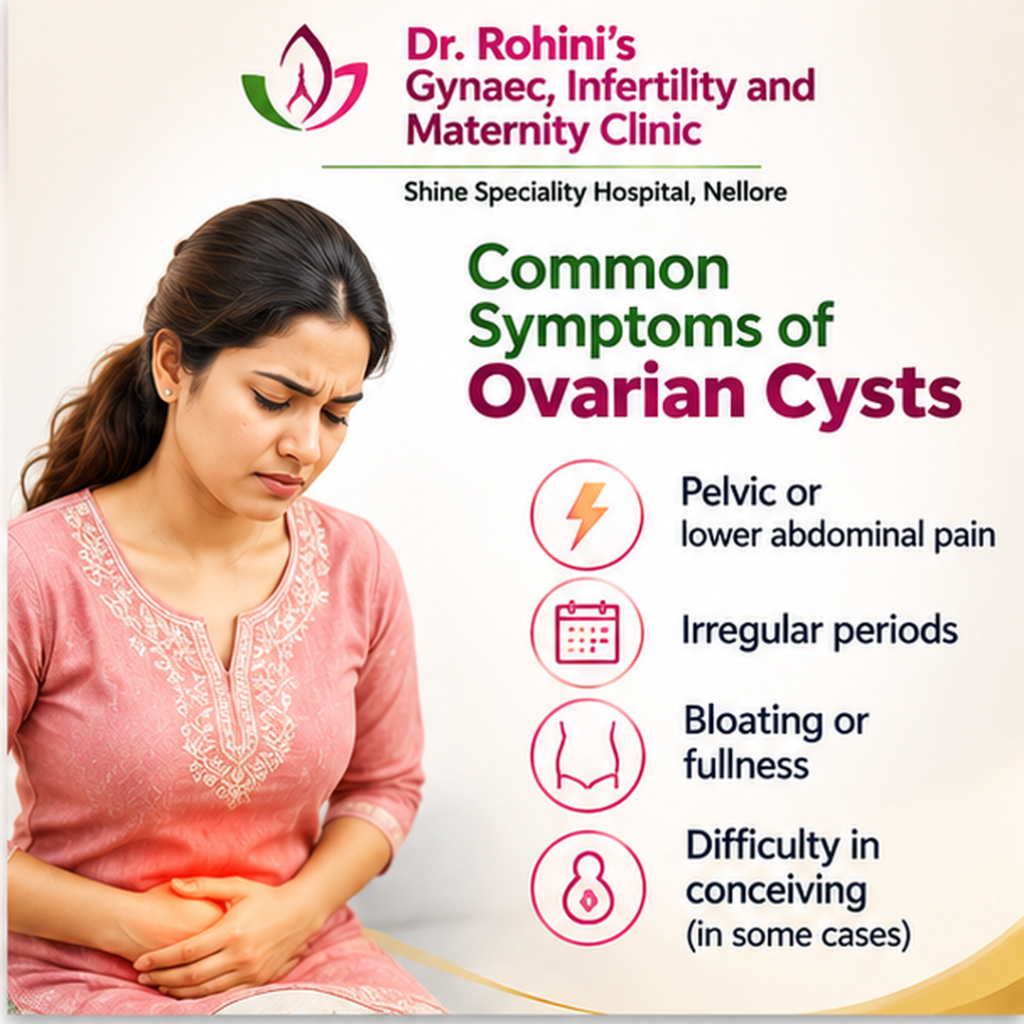
Symptoms of Ovarian Cysts – When Should You Consult a Gynecologist?
Many ovarian cysts do not cause symptoms and are discovered incidentally during an ultrasound examination.
However, some women may experience:
- Lower abdominal or pelvic pain.
- Pain on one side of the lower abdomen.
- Abdominal bloating or swelling.
- Pain during sexual intercourse.
- Irregular or painful menstrual periods.
- Frequent urination or pressure on the bladder.
- Feeling full quickly while eating.
- Difficulty becoming pregnant in some cases.
When should you seek urgent medical attention?
Sudden, severe abdominal or pelvic pain, particularly when accompanied by nausea, vomiting, dizziness, fainting or fever, needs urgent medical assessment.
These symptoms may indicate ovarian torsion (twisting of the ovary), cyst rupture or internal bleeding. Do not wait for a routine appointment if these symptoms occur.
Causes and Risk Factors of Ovarian Cysts
Ovarian cysts can develop for several reasons.
Common causes and associated factors include:
- Normal menstrual cycle: Hormonal changes during ovulation can lead to functional cyst formation.
- Endometriosis: Endometriosis can affect the ovaries and cause endometriomas.
- Pregnancy: A corpus luteum cyst may be present during early pregnancy.
- Previous ovarian cysts: Some women may develop ovarian cysts again.
- Hormonal stimulation: Certain fertility treatments can be associated with ovarian enlargement or cyst formation.
- Menopause: Ovarian cysts can also occur after menopause and need assessment based on their appearance and individual risk factors.
Not every ovarian cyst has an identifiable cause. Having an ovarian cyst does not automatically mean that you have ovarian cancer.
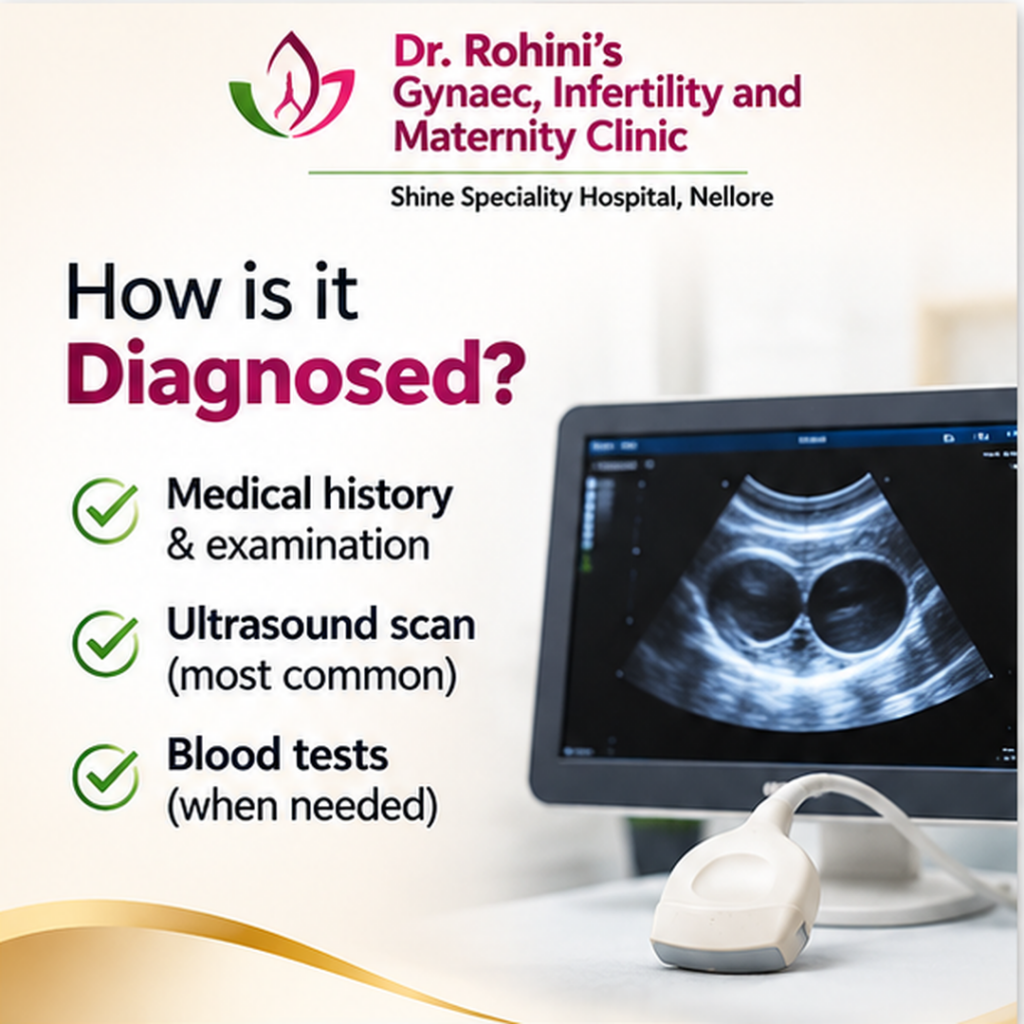
How Are Ovarian Cysts Diagnosed?
An appropriate diagnosis helps determine whether the cyst needs observation, further investigation or treatment.
The evaluation may include the following:
1. Medical history
Your gynecologist may ask about:
- Menstrual cycle and period-related symptoms.
- Abdominal or pelvic pain.
- Previous ovarian cysts or surgeries.
- Pregnancy history and fertility plans.
- Family history of ovarian or breast cancer.
- Menopausal status.
2. Clinical examination
An abdominal and, when appropriate and with consent, pelvic examination may help assess tenderness, discomfort or a pelvic mass.
3. Ultrasound examination
Ultrasound is an important investigation for ovarian cyst assessment.
It helps evaluate:
- Location of the cyst.
- Size of the cyst.
- Whether it is fluid-filled or contains solid components.
- Whether it has simple or complex features.
- Whether one or both ovaries are affected.
Depending on the clinical situation, an abdominal or transvaginal ultrasound may be recommended.
4. Blood investigations
Blood tests may be recommended in selected cases.
For example, CA-125 may be considered when the patient’s age, menopausal status, symptoms and ultrasound findings indicate a need for further assessment.
CA-125 alone cannot confirm or exclude ovarian cancer.
5. Additional imaging
MRI or other investigations may be considered when ultrasound findings require further clarification.
Not every patient needs all these investigations. Testing should be based on individual clinical findings.
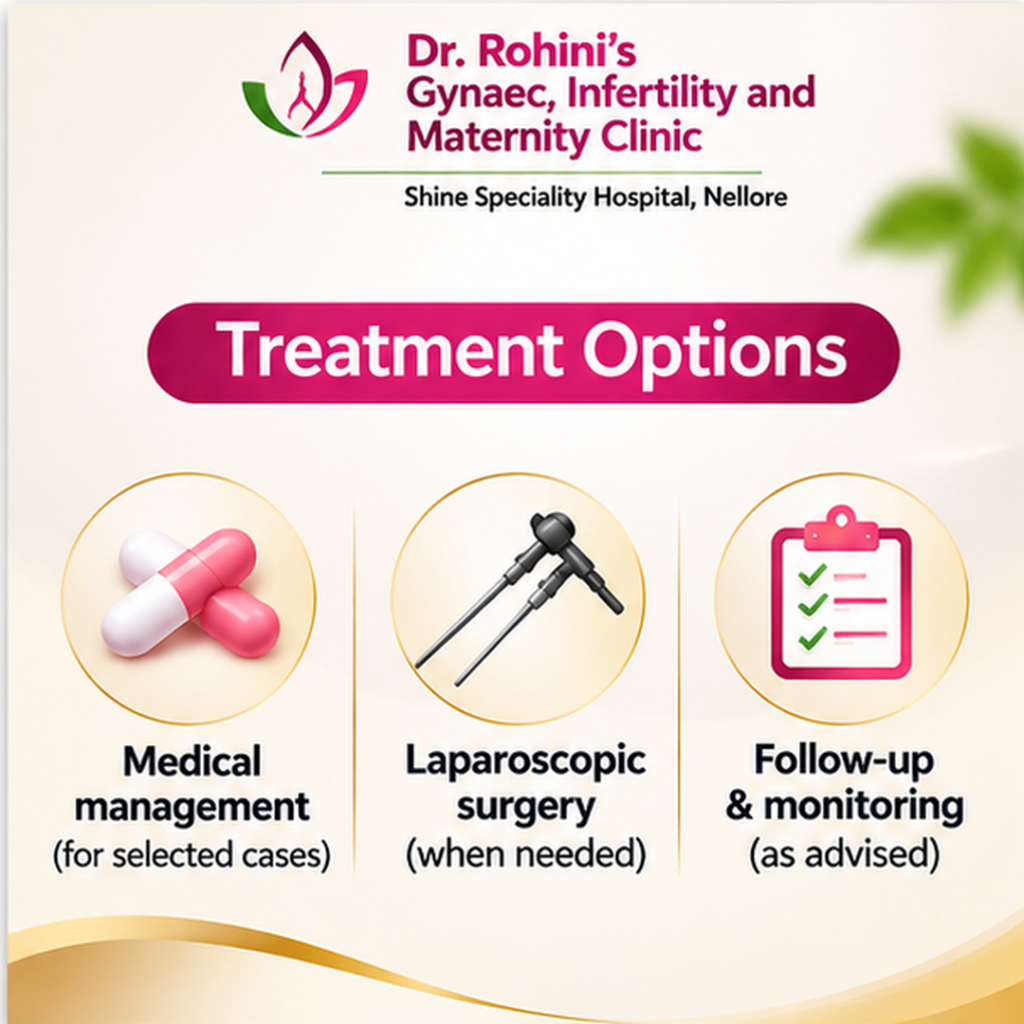
Ovarian Cyst Treatment in Nellore: Available Treatment Options
Does every ovarian cyst require surgery?
No. Many ovarian cysts do not require immediate treatment.
The management plan depends on the cyst’s size, type, ultrasound appearance, symptoms, age, menopausal status and fertility plans.
A. Conservative management and observation
Small, simple ovarian cysts, particularly in women before menopause, may disappear naturally.
Your gynecologist may recommend:
- Monitoring symptoms.
- Repeat ultrasound when clinically indicated.
- Periodic clinical review.
- Further investigation if the cyst changes or persists.
Observation is an active management approach, not neglecting the condition.
B. Medical management
Medication may be used to manage associated symptoms, depending on the underlying condition.
For example:
- Pain-relieving medicines may help control pelvic pain.
- Hormonal treatment may be considered for associated conditions such as endometriosis.
It is important to understand that hormonal contraceptive pills do not make an existing functional ovarian cyst disappear faster.
There is no single medication that can reliably dissolve every type of ovarian cyst.
C. Treatment of associated conditions
Some ovarian cysts are linked to underlying conditions.
For example, an endometrioma may require assessment for endometriosis, especially when the patient experiences severe period pain or difficulty conceiving.
Treatment should consider both symptom control and future reproductive plans.
D. Surgical treatment
Surgery may be considered when:
- The cyst is large or continues to grow.
- The cyst persists on follow-up assessment.
- Significant symptoms are present.
- Ultrasound findings are complex or concerning.
- There is suspicion of ovarian torsion or another complication.
- Further evaluation indicates that surgical removal is appropriate.
The decision should be made after discussing the potential benefits, risks and alternatives.

My Clinical Approach to Ovarian Cyst Treatment
At Dr. Rohini’s Gynaec, Infertility and Maternity Clinic, Nellore, the approach to ovarian cyst management begins with understanding the patient’s individual condition.
My clinical approach focuses on:
Careful evaluation: Understanding symptoms, menstrual history, previous medical conditions and ultrasound findings.
Individualised treatment: Not every ovarian cyst requires medication or surgery. Treatment decisions should be based on the clinical assessment.
Fertility considerations: For women planning pregnancy, preserving ovarian function and reproductive potential is an important consideration.
Clear counselling: Explaining the nature of the cyst, available treatment choices and the reasons for recommending a particular approach.
Appropriate follow-up: Monitoring the condition when necessary and reassessing if symptoms or imaging findings change.
The aim is to choose an appropriate treatment plan while avoiding unnecessary investigations and interventions.
When Is Surgery Required for an Ovarian Cyst?
Not all ovarian cysts require surgery. However, an operation may be recommended in selected situations.
These include:
- Persistent or enlarging ovarian cysts.
- Large cysts causing pressure or discomfort.
- Cysts associated with significant pain.
- Certain dermoid cysts or endometriomas.
- Complex cysts requiring surgical assessment.
- Suspected complications or concerning features.
What are the surgical options?
Ovarian cystectomy
Ovarian cystectomy involves removing the cyst while preserving the remaining healthy ovarian tissue whenever feasible.
This may be considered for women who wish to preserve their fertility.
Oophorectomy
Oophorectomy means removal of an ovary. It may be necessary in selected circumstances, such as when the ovary is extensively damaged or the clinical findings warrant removal.
Laparoscopic surgery
Laparoscopy, also called keyhole surgery, may be suitable for selected patients. It involves operating through small abdominal incisions using a camera and specialised instruments.
The choice between laparoscopic and open surgery depends on cyst size, characteristics, surgical considerations and the possibility of malignancy.
When there is significant suspicion of ovarian cancer, referral to an appropriate gynaecological oncology specialist is important.
The surgical approach and fertility implications should always be discussed before an operation.
Ovarian Cyst Treatment for Women from Nellore and Nearby Towns
Women from Nellore and surrounding areas may seek gynaecological consultation when an ovarian cyst is detected during an ultrasound examination or when they experience pelvic pain, menstrual problems or fertility concerns.
Dr. Rohini’s Gynaec, Infertility and Maternity Clinic is located in Nellore, Andhra Pradesh.
Women travelling from nearby areas such as:
- Gudur
- Kovur
- Kavali
- Other surrounding areas of Nellore district
can seek consultation for evaluation and guidance regarding ovarian cysts.
Patients are encouraged to bring previous ultrasound reports, blood investigations and medical records to help make the consultation more useful.
What to Expect During Your Consultation
If you visit for an ovarian cyst evaluation, the consultation may involve the following steps:
Step 1 – Discuss your concerns
You can explain your symptoms, menstrual history, pain and any previous diagnosis.
Step 2 – Review medical history
Your previous ultrasound scans, treatment history and fertility plans will be considered.
Step 3 – Clinical examination and investigations
An examination or additional investigations may be advised when clinically necessary.
Step 4 – Understand the diagnosis
The type, size and ultrasound characteristics of the cyst will be assessed.
Step 5 – Discuss treatment choices
You will be guided regarding observation, medical management, further investigations or surgery, depending on your condition.
Step 6 – Individualised treatment plan
A management plan will be discussed based on your age, symptoms, reproductive plans and overall health.
Step 7 – Follow-up
Follow-up appointments or repeat scans may be recommended depending on the diagnosis.
Frequently Asked Questions About Ovarian Cysts
Can an ovarian cyst disappear without surgery?
Yes. Many functional and simple ovarian cysts disappear naturally over a few menstrual cycles. However, some cysts persist and require monitoring or treatment. The decision depends on the ultrasound findings and clinical assessment.
What size of ovarian cyst requires surgery?
There is no single size that automatically means surgery is required. The decision depends on the cyst’s appearance, symptoms, growth, age and menopausal status. Some larger cysts may need additional assessment, while certain smaller cysts may require attention because of their characteristics.
Can ovarian cysts affect pregnancy?
Many women with ovarian cysts can become pregnant naturally. However, certain conditions, particularly endometriosis, may affect fertility. The impact depends on the type of cyst and the overall reproductive health of the woman.
Is an ovarian cyst the same as PCOS?
No. An ovarian cyst is a fluid-filled sac in or on the ovary. PCOS (Polycystic Ovary Syndrome) is a hormonal and metabolic condition that can affect ovulation and menstrual cycles. They are different conditions.
Can an ovarian cyst cause irregular periods?
Some ovarian conditions may be associated with menstrual changes. However, irregular periods can also occur due to hormonal imbalance, PCOS, thyroid disorders and other causes. Proper evaluation helps identify the underlying reason.
Is an ovarian cyst dangerous?
Most ovarian cysts before menopause are benign. However, certain cysts can cause complications such as twisting or rupture. Cysts detected after menopause also need appropriate assessment because the risk profile differs.
Will my ovary be removed if I undergo ovarian cyst surgery?
Not necessarily. In many suitable cases, the surgeon may remove only the cyst and preserve the healthy ovarian tissue. However, removal of an ovary may be necessary in certain situations. This should be discussed before surgery whenever possible.
Can ovarian cysts come back after treatment?
Yes. New cysts can develop even after a previous cyst has been treated or removed. The possibility of recurrence depends on the type of cyst and the underlying condition.
🌸 Concerned about an ovarian cyst?
Not every ovarian cyst needs surgery. The right treatment depends on its size, type, symptoms and your reproductive plans.
Get an appropriate evaluation and personalised treatment guidance.
👩⚕️ Dr. Rohini Udayagiri, MS (OBG)
15 Years of Experience in Obstetrics & Gynaecology
🏥 Dr. Rohini’s Gynaec, Infertility and Maternity Clinic
Shine Hospital
📍 Nellore, Andhra Pradesh
📞 Appointments: 9490880960
Your health deserves informed and compassionate care. 💗
Trusted Medical Resources About Ovarian Cysts
For additional patient education, you may refer to the following trusted medical resources:
- American College of Obstetricians and Gynecologists (ACOG): Ovarian Cysts – Symptoms, Diagnosis and Treatment
- NHS (National Health Service): Ovarian Cysts – Causes, Symptoms and Treatment
- Royal College of Obstetricians and Gynaecologists (RCOG): Ovarian Cysts Before Menopause
These resources provide additional information about ovarian cysts, investigations and treatment options.